


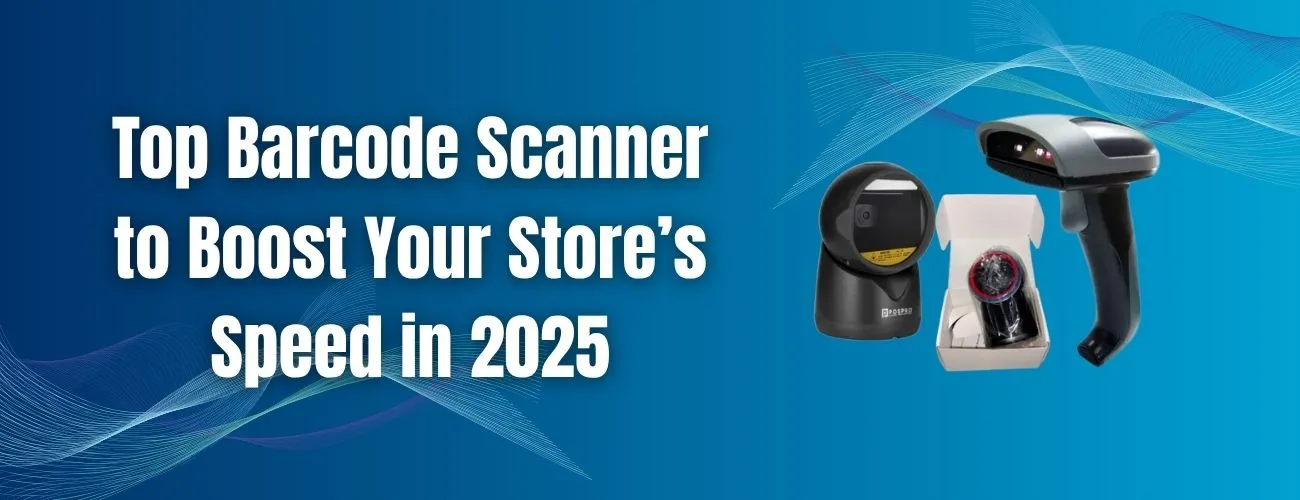
Barcode Scanner Price in Pakistan — Types, Uses & Cost
A barcode scanner captures and decodes a barcode value and is a vital instrument in the modern retail, logistics, and healthcare industries. Fast checkout, reduced error rates, and effective inventory tracking are some of the things barcode scanner data value in a business. Whether it is an automatic barcode scanner in a warehouse or a product scanner in a store, barcode scanning and interpretation technology are everyday business activities.
The advancements in scanner technology from bulky and clunky wireless devices to streamlined wireless devices that incorporate computer scanner systems and Bluetooth scanner systems are something to behold. This article addresses the underlying principles of all barcode scanners, how they are different from each other, and some of the pros and cons of the different barcode scanners. Lastly, this article addresses business automation and barcode scanner device improvements.
What Is A Barcode Scanner?
A barcode scanner product captures and decodes a barcode. Each individual scanner is limited to a particular barcode scanner type. This means that a particular scanner can only read a particular format and style of barcode. Each scanner reads the blank spaces of varying widths in a code and the thin and thick lines, and each scanner type decodes the patterns into different electronic readout readings. Each scanner type converts the patterns into electronic signals that are capable of being processed and displayed in a computer or POS system. Most common scanner applications include fast checkout and product and inventory tracking in retail and warehouse settings, and recordkeeping in libraries and healthcare in systems where barcode scanners are integrated to real-time item tracking.
Barcode scanners eliminate the need to manually enter data, resulting in increased operational efficiency in numerous sectors and operations.
How Much Does a Barcode Scanner Cost?
The barcode scanner cost in Pakistan depends on the type, brand, and intended use. Whether you are running a small retail shop or managing a large warehouse, there is a scanner priced for every operational need.
| Scanner Type | Price Range (PKR) | Best For |
| Basic Handheld (1D) | PKR 3,000 – PKR 8,000 | Small shops, grocery stores |
| Wireless / Bluetooth | PKR 10,000 – PKR 18,000 | Retail counters, mobile use |
| 2D / QR Code Scanner | PKR 15,000 – PKR 25,000 | eCommerce, logistics, hospitals |
| Industrial / Automatic | PKR 30,000 – PKR 45,000+ | Warehouses, production lines |
| Fixed Mount Scanner | PKR 20,000 – PKR 35,000 | Conveyor belts, automated lines |
Quick Answer: A basic barcode scanner costs between PKR 3,000 and PKR 8,000 for everyday retail use. Mid-range wireless scanners fall between PKR 10,000 and PKR 25,000, while industrial-grade models start from PKR 30,000 and go higher depending on specifications.
Barcode Scanner Types
1. Laser Barcode Scanners
The scanners are the most popular in the retail sector, mostly due to their efficiency. These scanners are a common sight at retail checkout counters, and their rapid scanning capabilities are ideal for product scanner use.
2. CCD (Charge Coupled Device) Scanners
These scanners are more cost efficient, which is appropriate for businesses sized and lessened operational capabilities.
3. 2D / QR Code Scanners
These scanners expand the functionality and usage of the older 1D barcode scanners because they also read modern QR codes, making various industries like logistics and ecommerce more efficient.
4. Barcode scanners that work over Wi-Fi and Bluetooth
Bluetooth barcode scanners are best for big stores, warehouses, and delivery services because they are more portable and easier to use.
5. Barcode Scanners for Business
In heavy manufacturing and logistics, barcode scanners are common and built to withstand the rigors of continuous industrial use.
Reasons to Use Barcode Scanners
- Speed and Accuracy: Scanners speed up workflows and cut down on mistakes that happen when people enter data by hand at the same time.
- You can quickly see how much stock you have and where it is with better inventory management.
- Scanners make operations more efficient by reducing data loss and collecting huge amounts of data that would take hours to gather and record.
- Easy to connect: Different scanners can easily work with different software and point-of-sale systems.
- Automated Scanning – These scanners are less manual and more automated.
Barcode Scanners Sectors
Tracking supermarkets and stores is easy.
The warehouse and logistics management simplifies the stock and order management.
Monitoring patients, prescriptions and other stakeholders.
- Production: Quality control & output were improved.
- Libraries & Education: Keeping track of student and resource IDs.
- Hospitality & Events: Checking in guests and validating tickets.
Factors to Consider When Buying a Barcode Scanner
- Compatibility: Confirm that the scanner will work with your computer or POS system.
- Connection Type: Consider the wired, wireless, and Bluetooth available options.
- Scanner Type: Confirm whether you require 1D or 2D scanning.
- Grade: If you need an industrial-grade or commercial-grade scanner, it will depend on usage.
Remember that the warranty will determine the technical assistance available, and quality support comes from reputable companies.
Most Trusted Barcode Scanner Brands
Some of the most trusted barcode scanner companies are:
- Honeywell – Recognized for both speed and precision.
- Zebra – Provides robust, high-functioning scanners.
- Datalogic – Excellent for both retail and warehousing.
- Symbol (Motorola) – Best for handheld scanning.
- Newland & Eyoyo – Small businesses will enjoy their compact and budget friendly scanners.
These brands represent the best in innovation, performance and dependability in barcode technology.
10 Uses of a Handheld Barcode Scanner Across Industries
A handheld barcode scanner is one of the most versatile tools a business can invest in. Its applications stretch far beyond the retail checkout counter — here are ten real-world uses that demonstrate exactly why these devices have become essential across multiple sectors:
- Retail Checkout — Scanning product barcodes at the point of sale speeds up billing and eliminates manual entry errors, cutting queue times significantly in busy stores.
- Warehouse Inventory Management — Staff use handheld scanners to log incoming stock, track item locations across shelves, and process outgoing orders without paper-based recordkeeping.
- Hospital Patient Tracking — Healthcare facilities use handheld scanners to match patient wristbands with prescriptions, lab samples, and medical records, reducing the risk of medication errors.
- Pharmacy Prescription Verification — Pharmacists scan medicine barcodes to verify that the right drug, dosage, and batch number are being dispensed to the correct patient.
- Library Book Management — Libraries rely on handheld scanners to issue books, process returns, and run stock audits across thousands of titles quickly and accurately.
- eCommerce Order Fulfilment — Picking and packing teams in fulfilment centres scan items at multiple stages — pick, pack, and dispatch — to ensure order accuracy before shipping.
- Event Ticketing and Guest Check-In — At concerts, conferences, and corporate events, handheld scanners verify digital and printed tickets instantly, reducing entry bottlenecks.
- School and University ID Tracking — Educational institutions use scanners to manage student attendance, library access, and resource allocation linked to student ID barcodes.
- Manufacturing Quality Control — On production lines, handheld scanners verify that components and finished products meet batch and specification requirements before moving to the next stage.
- Delivery and Courier Tracking — Delivery staff scan parcels at collection, transit, and delivery points to update tracking systems in real time, giving both businesses and customers live shipment visibility.
Barcode Scanner s Efficiency on Business Processes and Operations
Barcode scanners’ most immediate effect on business processes is the automation of data capture. Operations can also be done at a faster pace. Think about a retail chain that uses a barcode scanner. Such a scanner makes automatic sales tracking and restocking possible and updates customer information in real time.
Automated scanning systems alleviate the need for manual entry in industrial settings. For example, the RN scanner process house and digital press system accurately tracks batches and updates information in real time.
How to Maintain Your Barcode Scanner
- Perform repairs to prevent the scanner from malfunctioning.
- Ensure the scanner lens is kept clean.
- Avoid dropping the scanner, and keep it out of direct sunlight.
- Perform updates and repairs to improve scanners and add new capabilities.
- Use protective carrying cases for handheld scanners and devices.
- Scanners need to be stored safely and in dry areas when not in use.
Future of Scanning Technology
Due to automation and artificial intelligence, the barcode industry is evolving rapidly. Future barcode scanners will have advanced smart image recognition, mobile scanning, and other cutting-edge features that will make them more accurate than automatic scanners. Enhanced scanning capabilities will be supported with tools like mobile apps and systems, and voice commands will be incorporated for hands-free scanning.
Conclusion
The scanner barcode system has developed from the retail counter to the industrial warehouse. Due to its rapid, accurate, and versatile scanning features, it has become essential in every industry’s data management. Whether automating and streamlining operational flows of production, eCommerce, logistics, or smart management, every scenario and context has to be well matched to the right type of scanner, be it Bluetooth for mobility, eCommerce transaction handheld scanners, or automatic production line scanners.
Find the Right Barcode Scanner for Your Business
Need to identify the best barcode scanner for your business? Browse our catalog, or contact us to receive a free consultation. We will help you determine which model is best for your operation.
Questions About Barcode Scanners
1. What is a Barcode reader & how does it work?
A barcode scanner is an electronic device that reads printed barcodes by emitting a beam of light — either a laser or LED — and capturing the reflected pattern. The reflected signal is converted into digital data and sent to a connected computer or POS system for processing. The entire process takes a fraction of a second and eliminates the need for manual data entry.
2. What are the major types of barcode scanners?
The main types are laser handheld scanners, CCD scanners, 2D and QR code scanners, Bluetooth wireless scanners, and fixed-mount industrial scanners. Each type is suited to a different environment — retail, warehouse, healthcare, or production.
3. Can I use a barcode scanner with my computer or POS system?
Barcode scanners are plug and play systems that communicate with POS and computer systems wirelessly, as well as Bluetooth, USB, or other wireless systems. They work with Windows and macOS computers as well as POS.
4. What is the difference between a 1D and a 2D barcode scanner?
A 1D scanner reads horizontal line barcodes found on most retail products. A 2D scanner reads matrix codes like QR codes, which store significantly more data including URLs, batch numbers, and product details. If your business deals in eCommerce or logistics, a 2D scanner is the better long-term investment.
5. Are barcode scanners compatible with mobile devices?
Most Bluetooth scanners work with smartphones and tablets which is great for delivery tracking and mobile businesses.
6. How do I choose the best barcode scanner for my business?
Think about the distance it will need to scan, and if you want it to be connected via wire or if it will need to scan wirelessly. You also want to think about if you need to scan 1D or 2D barcodes and the place where it will be used like, for example, retail, warehouse, or healthcare.


