


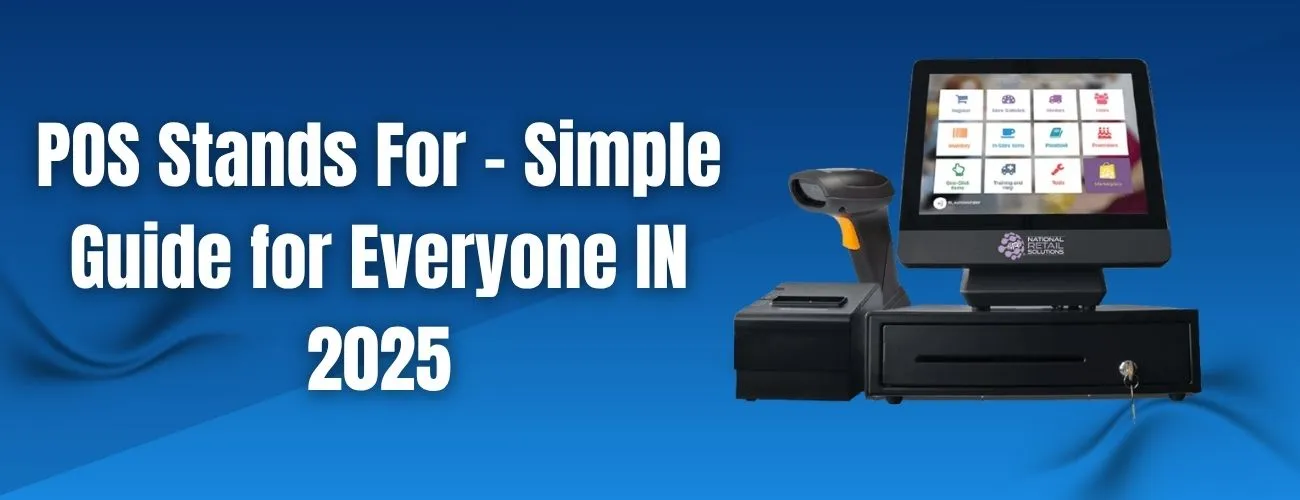
Easy Meaning and Complete Guide
When you walk into a store or restaurant and pay someone, you use a process that most folks probably don’t think about. Records are how clinics and many businesses keep track of things, and are how most businesses store their information. Knowing how modern businesses operate is understanding how a pos system works.This is important because literally every business depends on it. A small retail store, a bank, a cafe, or a medical clinic uses a POS system everywhere. POS stands for Point of Sale, and this system is also known as a checkout system or billing software. Its understanding helps students, new business owners, and anyone who wants to learn how record keeping and payments work today.
What Is POS Stands For?
POS means Point of Sale. This is where a customer pays for a product or service, such as a store countertop, a restaurant cashier desk, or an online checkout. Simply put, it is where a sale occurs.
Some examples are as follows:
- In a store, a cashier scans items with a POS machine to receive payment.
- At a cafe, an employee takes your order on a POS system.
- When buying items in a store online, the checkout page is a POS.
- POS has different meanings in different industries. Knowing these meanings are important.
POS stands for in computer
In computers, POS is used as the abbreviation for Point of Sale Software. This is the software that controls sales, inventory, receipts, and reports.
POS stands for in banking
In banking, a POS is a Point of Sale terminal. This is the terminal where you insert or tap your ATM or debit card.
POS stands for in business
In a business, a POS system is used to refer to the entire system that deals with sales, stock, and customer information.
POS stands for in retail
In retail, the POS system records sales, adjusts inventory, and provides a receipt.
POS stands for in medical billing
In medical billing, POS means the location where the service was provided, for instance, a hospital or a clinic.
POS meaning slang
As for slang, POS can mean something somewhat negative, but this is unrelated to business or technology.
What is a POS person?
A POS person is commonly regarded as the person using a Point of Sale system. This is a cashier, sales, or customer service staff member who processes payments.
Why POS Matters – The Key Benefits
A POS system makes everyone’s lives easier. Customers can pay quickly, and business owners have an easier way to manage everything. One major benefit is accuracy. Because everything is inputted electronically, there is less room for mistakes. Cashiers do not need to remember prices because the system does it for them. Another advantage is speed.
A POS system also lets business owners track their inventory. They know which products are low, which ones are selling quickly, and which ones need to be restocked. For banks, POS terminals allow customers to pay without cash, which is always more secure and reliable.
How a POS System Works
A point-of-sale system works in a simple step-by-step process; it looks complex. Its main function is simple. First, the item is either scanned or entered into the system. The system then displays the price and calculates the total. Then the customer pays with cash, credit card, or mobile wallet.
The system records the payment and issues a voided check or sends a digital receipt. The system then updates the stock levels, generates a report, and records the information safely. The process is the same for online purchasing. In this instance, the customer selects the items they want, goes to the ‘checkout,’ pays for the items, and receives a purchase confirmation.
A Point Of Sale system usually includes:
- A device like a computer, phone, or tablet
- POS software
- Tools to facilitate payment, like a credit card reader
- Receipts, either printed or digital.
- Modern POS systems also support cloud systems, which means the information is stored online and is accessible from anywhere.
Tips for Using a POS System
If you are unfamiliar with the basics of POS systems, that’s okay. Here are some easily applicable suggestions that can be implemented right away:
- If possible, get familiar with the system’s primary functionalities first. There is no need to get bogged down with every detail on the first day. Master the skills of product entry, payment processing, and receipt issuing first.
- Keeping the software up-to-date is a must. It allows the system to function at optimum efficiency and minimizes the likelihood of errors. Prior to verifying a sale, always review the entries to ensure that your records remain accurate.
- Always have your device either charged or plugged into the wall. Some POS systems will cease functioning if the device’s battery is dead.
- Invest time in training your employees. A well-oiled machine is only as good as its weakest link. Some small, simple steps can drastically improve the quality of daily operations.
Common Mistakes and Myths About POS
Some believe that Point of Sale (POS) systems are only for use by large corporations. This is false. POS systems are utilized by small stores, home businesses, and market booths. People believe POS systems are difficult. Modern systems are made to be very simple. They emulate the functionality of a smartphone application.
Some store owners think that a traditional notebook is adequate. Handwritten records can be lost or damaged, though, while digital systems lack that vulnerability. People tend to ignore backup systems. Most systems offer a backup to the cloud. Neglecting this is exposing yourself to a significant risk of losing data. Another issue is using obsolete technology.
POS System Benefits
Experts agree that businesses utilizing a POS system are more successful. Most businesses that implement digital systems have increased customer satisfaction, decreased errors, and increased profits. They also cite that more than 70% of consumers prefer businesses that implement digital payment systems.
In the banking industry, POS terminals are used to process millions of transactions each day, demonstrating the system’s reliability. Medical facilities that implement POS billing sustain fairer, cleaner records and report a notable decrease in billing errors. POS systems are also recommended to be based on the size of the business.
Final Thoughts
Knowing what POS means makes it easy to appreciate how vital this system is in everyday life. Computers, retail, banking, medical billing, etc., have POS for efficient and secure transactions.
It also systematizes operations, minimizes errors, and enables business expansion. If you want to start a business or if you want to scale your already existing business, understanding POS is a great first step, and you should start small. The system becomes easier to navigate with time.
FAQ’s
A POS works by instantaneously recording the sale into the system, and it does that by scanning or entering items, calculating a total, collecting a payment, and closing the transaction.
POS means Point of Sale, and ATM is for Automated Teller Machine.
A POS transaction is a type of transaction made at the point of sale where the customer purchases the item or service, whether physically or virtually.
In banking, POS means “Point of Sale,” and it refers to the device or terminal that processes card payments.


